Counter-Tariffs Will Hurt Canadians More Than Americans: Why Ottawa's Retaliation Strategy Backfires
On September 8, 2026, Canada imposed a 50% surtax on U.S. steel. The announcement played well in Ottawa. The problem is, the Canadian importer pays it, not the American mill.
The surtax is a domestic tax that lands on the balance sheet of a Canadian company that still needs the same steel it needed the day before. The foreign exporter sees nothing. The Canadian buyer sees a jump in input costs, which either compresses margin or gets passed to the customer. Either way, the hit is local. That's what nobody explains when the government announces C$27.6 billion in retaliatory measures.
Who actually pays when we retaliate
Canada sends 68% of its exports to the United States. The U.S. sends roughly 15% of its exports to Canada. When both sides impose reciprocal tariffs, the side with the higher dependency absorbs more of the pain. That's not ideology. It's arithmetic.
During the 2018 steel and aluminum dispute, Canada targeted U.S. yogurt, whiskey and lawnmowers, products chosen to apply political pressure on specific congressional districts. The strategy worked in the sense that it created noise. It failed in the sense that Canadian consumers paid higher prices for those goods for the duration of the dispute, and the affected U.S. manufacturers mostly shrugged and sold domestically or rerouted to Mexico.
The theory behind retaliation is that pain on the U.S. side will force Washington to back down. The flaw is that the pain is almost never proportional. A tariff on bourbon from Kentucky matters to bourbon producers. It does not move the national conversation in a country where Canada accounts for less than one-fifth of export demand. A tariff on U.S. machinery parts, by contrast, hits Canadian manufacturers who have no alternative supplier and need those parts to fulfill contracts they've already signed. The trade flows aren't symmetrical, and pretending they are is expensive.
The strongest objection here is that doing nothing makes Canada look weak and invites further protectionist moves. That's true. The choice isn't binary between retaliation and silence. But if the goal is to minimize damage to Canadian businesses and households, the current playbook is upside down.
What retaliation actually costs Canadian businesses
Canadian manufacturers rely heavily on U.S. intermediate goods, components used in domestic production. A surtax on those components raises the landed cost for the Canadian buyer. If the buyer is producing for export back to the United States, they're now less competitive against U.S. firms that source the same parts domestically at no surtax. If they're producing for the Canadian market, they pass the cost forward or eat the margin hit.
The CUSMA agreement includes dispute resolution mechanisms, but those processes take years. In the interim, the tariff stays in effect. During the last major trade dispute, businesses that moved quickly to stockpile inventory before the surtax implementation date gained a temporary cost advantage. Most didn't. The tariff went live, input costs jumped, and the competitive position of Canadian producers worsened while the two governments argued.
The currency effect compounds it. Trade uncertainty weakens the loonie. A weaker Canadian dollar makes U.S. imports more expensive even before the surtax. For a business importing U.S. components at a 25% surtax with the dollar down 8%, the combined hit is not addition, it's multiplication.
The revenue collected from these tariffs goes to the federal government. There is no automatic redistribution to the industries absorbing the cost. The funds sit as general revenue. The business that paid the surtax on the parts it needs to operate sees none of it back.
Ottawa's retaliation feels like fairness. It functions like a tax on the Canadian businesses least able to avoid it. That's not a strategy. That's theatre with a domestic price tag.



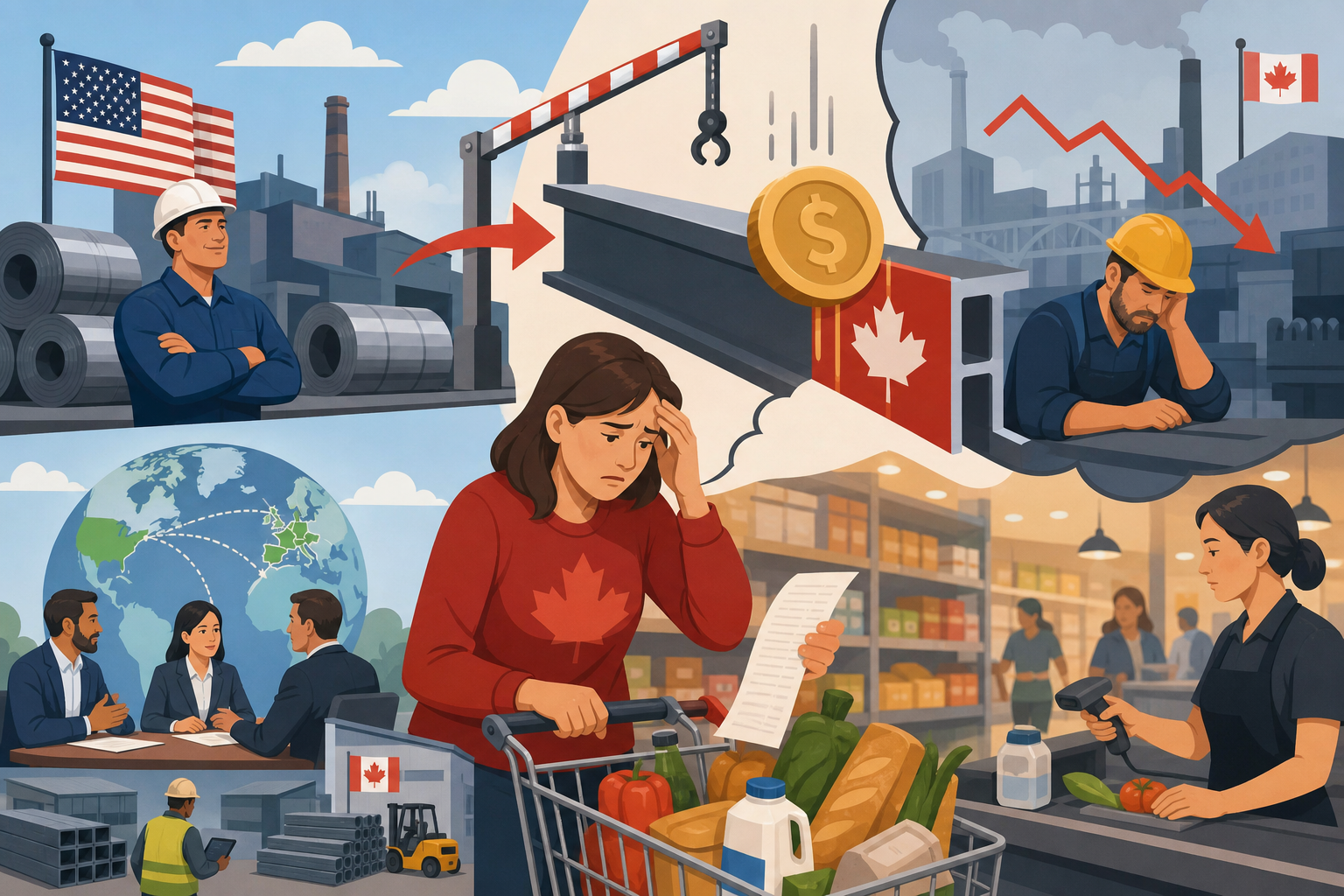

On September 8, 2026, Canada imposed a 50% surtax on U.S. steel. The announcement played well in Ottawa. The problem is, the Canadian importer pays it, not the American mill.
The surtax is a domestic tax that lands on the balance sheet of a Canadian company that still needs the same steel it needed the day before. The foreign exporter sees nothing. The Canadian buyer sees a jump in input costs, which either compresses margin or gets passed to the customer. Either way, the hit is local. That's what nobody explains when the government announces C$27.6 billion in retaliatory measures.
Who actually pays when we retaliate
Canada sends 68% of its exports to the United States. The U.S. sends roughly 15% of its exports to Canada. When both sides impose reciprocal tariffs, the side with the higher dependency absorbs more of the pain. That's not ideology. It's arithmetic.
During the 2018 steel and aluminum dispute, Canada targeted U.S. yogurt, whiskey and lawnmowers, products chosen to apply political pressure on specific congressional districts. The strategy worked in the sense that it created noise. It failed in the sense that Canadian consumers paid higher prices for those goods for the duration of the dispute, and the affected U.S. manufacturers mostly shrugged and sold domestically or rerouted to Mexico.
The theory behind retaliation is that pain on the U.S. side will force Washington to back down. The flaw is that the pain is almost never proportional. A tariff on bourbon from Kentucky matters to bourbon producers. It does not move the national conversation in a country where Canada accounts for less than one-fifth of export demand. A tariff on U.S. machinery parts, by contrast, hits Canadian manufacturers who have no alternative supplier and need those parts to fulfill contracts they've already signed. The trade flows aren't symmetrical, and pretending they are is expensive.
The strongest objection here is that doing nothing makes Canada look weak and invites further protectionist moves. That's true. The choice isn't binary between retaliation and silence. But if the goal is to minimize damage to Canadian businesses and households, the current playbook is upside down.
What retaliation actually costs Canadian businesses
Canadian manufacturers rely heavily on U.S. intermediate goods, components used in domestic production. A surtax on those components raises the landed cost for the Canadian buyer. If the buyer is producing for export back to the United States, they're now less competitive against U.S. firms that source the same parts domestically at no surtax. If they're producing for the Canadian market, they pass the cost forward or eat the margin hit.
The CUSMA agreement includes dispute resolution mechanisms, but those processes take years. In the interim, the tariff stays in effect. During the last major trade dispute, businesses that moved quickly to stockpile inventory before the surtax implementation date gained a temporary cost advantage. Most didn't. The tariff went live, input costs jumped, and the competitive position of Canadian producers worsened while the two governments argued.
The currency effect compounds it. Trade uncertainty weakens the loonie. A weaker Canadian dollar makes U.S. imports more expensive even before the surtax. For a business importing U.S. components at a 25% surtax with the dollar down 8%, the combined hit is not addition, it's multiplication.
The revenue collected from these tariffs goes to the federal government. There is no automatic redistribution to the industries absorbing the cost. The funds sit as general revenue. The business that paid the surtax on the parts it needs to operate sees none of it back.
Ottawa's retaliation feels like fairness. It functions like a tax on the Canadian businesses least able to avoid it. That's not a strategy. That's theatre with a domestic price tag.
Sources
Read Next
Before the October Bank of Canada Decision: 5 Questions to Ask Your Lender
Extend, Adjust or Let It Lapse: Weighing Canada's Foreign Buyer Ban Before Year End
From 6.4% to 6.5%: How a Small Shift Affects Self-Employed Mortgage Approvals
What BC's Wills Variation Law Means When Disinherited Siblings Threaten Court