Concert Tours and Revenge Travel Are Masking Canada's Real Hotel Recovery Problem
Toronto hotels booked 97% capacity the week Taylor Swift played the Rogers Centre. Vancouver hit 94% when Coldplay came through. Montreal pushed past 90% for Formula One weekend. The industry calls this the Experience Economy. A better term would be planned scarcity.
Those numbers are weekend spikes papered over a structural revenue problem that most operators would prefer you not notice.
The Revenue Lag Nobody Wants to Name
National occupancy is running in the mid-60% range for 2026, with seasonal peaks nudging past 75% in summer. RevPAR is up 4-7% year over year. Average Daily Rates in Toronto and Vancouver regularly exceed $300 during event windows. The talking points write themselves.
Look at what happens between the events. A 500-room property in downtown Toronto that runs 95% occupancy during a concert weekend drops to 58% the following Tuesday. The ADR collapses from $340 to $185. The blended weekly revenue barely clears what the hotel was doing in 2019, and 2019 revenue was benchmarked against mortgage rates under 3%. Renewal costs in 2026 are running north of 5.4%.
The industry has switched from selling rooms to selling scarcity. When an event is announced, rates spike immediately. Dynamic pricing software now adjusts ADR in real-time based on ticket sales and flight arrivals. It works. For the event. The problem is the 340 other nights of the year when there is no artificial demand ceiling and business travel has changed shape permanently.
Business Travel Is Back. The Money Isn't.
Group and convention bookings have returned to roughly 95-100% of 2019 volumes. That figure hides the margin problem. The 2026 business traveler extends a Tuesday-Thursday trip into a Sunday stay. Hotels call this "bleisure." What it actually means is that the weekday corporate rate now competes with leisure pricing expectations. A $280 Tuesday rate in 2019 is a $210 Tuesday rate in 2026 if the guest is staying through the weekend. Occupancy is in the mid-60s for the full week. Revenue per occupied night fell from $310 to $215.
Rural properties are bearing this gap hardest. Urban hotels can chase event-driven premiums. A 120-room property in Muskoka or the Interior BC has no Taylor Swift windfall coming. Those markets are sitting at occupancy in the low 60s with ADR growth under 3%. The national average RevPAR figure the industry promotes is a blended number weighted heavily toward six or seven metro cores that can manufacture scarcity through event programming.
The Supply Constraint Is Not a Strength
New hotel construction in Canada is projected to grow by less than 2% annually through 2026. High interest rates and construction costs have frozen the development pipeline. Existing operators are treating this as pricing power.
The lag before correction is what this actually is. When construction financing was cheap, overbuilding killed margins. Now underbuilding is holding ADR artificially high in markets where actual sustained demand does not justify it. Rates will fall as operators chase occupancy during the 48 weeks of the year when there is no stadium show to anchor demand.
A hotel that can fill at $340 during a concert will discount to $160 on a random March Wednesday to avoid running dark rooms. Yield desperation with good PR is what this is.
The industry moved past pandemic-era deep discounting, the reports say. What it actually did was concentrate discounting into the margins while using event premiums to flatten the average. The headline number hides the split.
Concert tours end. Revenge travel has a ceiling. The structural question is what the midweek, mid-season occupancy rate will support once consumers have finished spending money they did not spend in 2020. Event windfalls are replacing the recurring business travel margin that has not come back, a substitution of one-time paydays for the steady dollars that moved the needle in 2015 and 2016.



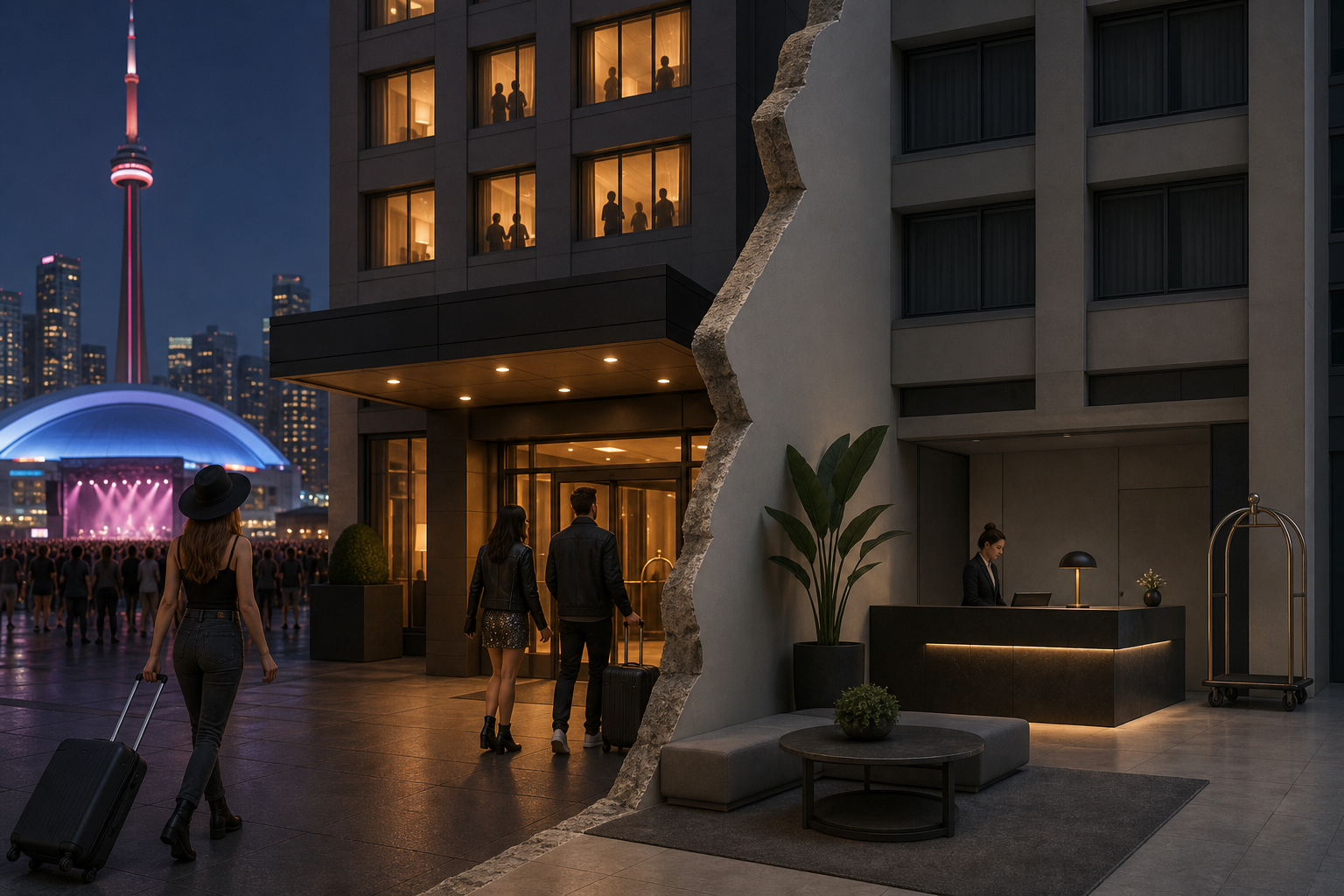

Toronto hotels booked 97% capacity the week Taylor Swift played the Rogers Centre. Vancouver hit 94% when Coldplay came through. Montreal pushed past 90% for Formula One weekend. The industry calls this the Experience Economy. A better term would be planned scarcity.
Those numbers are weekend spikes papered over a structural revenue problem that most operators would prefer you not notice.
The Revenue Lag Nobody Wants to Name
National occupancy is running in the mid-60% range for 2026, with seasonal peaks nudging past 75% in summer. RevPAR is up 4-7% year over year. Average Daily Rates in Toronto and Vancouver regularly exceed $300 during event windows. The talking points write themselves.
Look at what happens between the events. A 500-room property in downtown Toronto that runs 95% occupancy during a concert weekend drops to 58% the following Tuesday. The ADR collapses from $340 to $185. The blended weekly revenue barely clears what the hotel was doing in 2019, and 2019 revenue was benchmarked against mortgage rates under 3%. Renewal costs in 2026 are running north of 5.4%.
The industry has switched from selling rooms to selling scarcity. When an event is announced, rates spike immediately. Dynamic pricing software now adjusts ADR in real-time based on ticket sales and flight arrivals. It works. For the event. The problem is the 340 other nights of the year when there is no artificial demand ceiling and business travel has changed shape permanently.
Business Travel Is Back. The Money Isn't.
Group and convention bookings have returned to roughly 95-100% of 2019 volumes. That figure hides the margin problem. The 2026 business traveler extends a Tuesday-Thursday trip into a Sunday stay. Hotels call this "bleisure." What it actually means is that the weekday corporate rate now competes with leisure pricing expectations. A $280 Tuesday rate in 2019 is a $210 Tuesday rate in 2026 if the guest is staying through the weekend. Occupancy is in the mid-60s for the full week. Revenue per occupied night fell from $310 to $215.
Rural properties are bearing this gap hardest. Urban hotels can chase event-driven premiums. A 120-room property in Muskoka or the Interior BC has no Taylor Swift windfall coming. Those markets are sitting at occupancy in the low 60s with ADR growth under 3%. The national average RevPAR figure the industry promotes is a blended number weighted heavily toward six or seven metro cores that can manufacture scarcity through event programming.
The Supply Constraint Is Not a Strength
New hotel construction in Canada is projected to grow by less than 2% annually through 2026. High interest rates and construction costs have frozen the development pipeline. Existing operators are treating this as pricing power.
The lag before correction is what this actually is. When construction financing was cheap, overbuilding killed margins. Now underbuilding is holding ADR artificially high in markets where actual sustained demand does not justify it. Rates will fall as operators chase occupancy during the 48 weeks of the year when there is no stadium show to anchor demand.
A hotel that can fill at $340 during a concert will discount to $160 on a random March Wednesday to avoid running dark rooms. Yield desperation with good PR is what this is.
The industry moved past pandemic-era deep discounting, the reports say. What it actually did was concentrate discounting into the margins while using event premiums to flatten the average. The headline number hides the split.
Concert tours end. Revenge travel has a ceiling. The structural question is what the midweek, mid-season occupancy rate will support once consumers have finished spending money they did not spend in 2020. Event windfalls are replacing the recurring business travel margin that has not come back, a substitution of one-time paydays for the steady dollars that moved the needle in 2015 and 2016.
Read Next
Before the October Bank of Canada Decision: 5 Questions to Ask Your Lender
Extend, Adjust or Let It Lapse: Weighing Canada's Foreign Buyer Ban Before Year End
From 6.4% to 6.5%: How a Small Shift Affects Self-Employed Mortgage Approvals
What BC's Wills Variation Law Means When Disinherited Siblings Threaten Court