Canada Now Ships 71.7% of Exports to the U.S.: Why That Concentration Should Worry You
Iowa ships $4.9 billion worth of goods to Canada annually, which is roughly what Canada ships to the U.S. every 30 hours. That asymmetry tells you everything about the risk structure Canada is carrying right now.
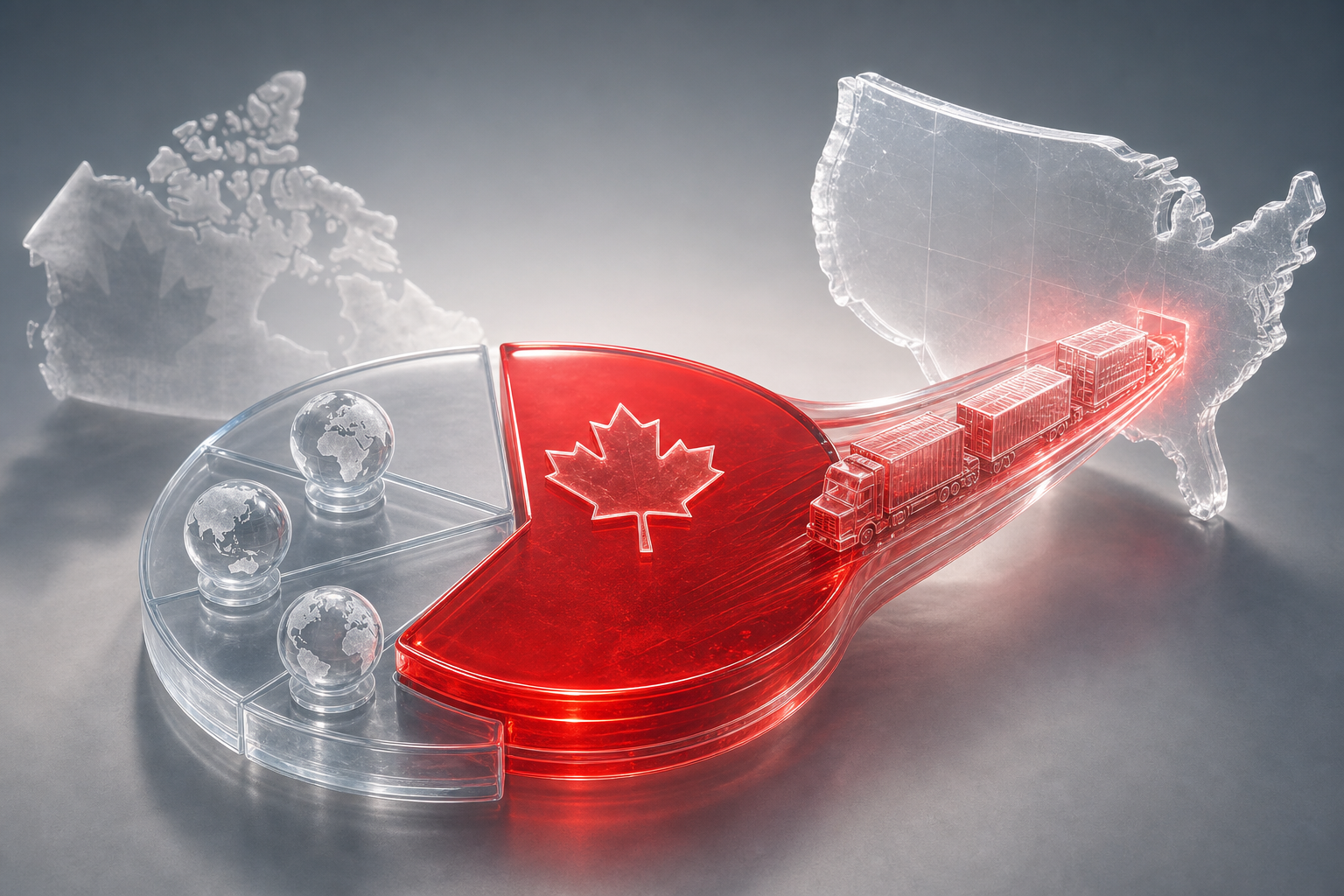
As of the end of 2025, Canada now sends 71.7% of its total exports to the United States, according to Statistics Canada. That figure was 15.41% the previous reporting period. The jump isn't a calculation error. It reflects a sustained multi-year trend where every other destination, Europe, Asia, emerging markets, has shrunk as a share of the total while the U.S. line has grown.
The number itself is just a ratio. The problem is what happens when the denominator stays fixed and one customer controls nearly three-quarters of your revenue.
Why diversification isn't just a nice idea
Most countries spread export risk across multiple regions because concentration creates brittleness. Germany sends roughly 9% of its exports to the U.S. and spreads the rest across the EU, China, and a dozen other major partners. If one market stumbles, the others buffer the shock.
Canada doesn't have that buffer. We send 71.7% to one buyer. Asia takes 11.2%. Europe takes 12.2%. The rest of the world combined accounts for barely 5%. That distribution makes Canada uniquely vulnerable to any policy shift, tariff escalation, or economic slowdown south of the border.
The standard defence is that the U.S. is stable, massive, and right next door. Fair. But stability in aggregate doesn't mean predictability in trade policy. The Trump administration imposed tariffs on Canadian steel and aluminum in 2018, calling Canada a national security threat. The Biden administration kept most of those measures in place. A future administration could do worse, and Canada would have no comparable alternate buyer ready to absorb the volume.
The arithmetic of a single-customer business
When one customer represents 71.7% of revenue, every decision that customer makes becomes your decision. If the U.S. rewrites environmental standards and your exports don't meet the new threshold, you retrofit or you lose the contract. If the U.S. shifts procurement to domestic suppliers under a Buy American provision, you eat the margin loss or shut capacity.
This dynamic already plays out in Canadian energy. Ontario exports 12 terawatt-hours of electricity to the U.S. annually, roughly 15% of the province's total generation. That power flows because U.S. grids need it and the regulatory frameworks align. A policy change in one midwestern state can reshape the revenue model for an entire generating asset. There is no equivalent buyer waiting in Asia or Europe to take 12 TWh of baseload power.
The same logic applies to agriculture, forestry, autos, machinery. The U.S. takes the volume because it's big, close, and connected by roads, rail, electrical lines, and port facilities built over decades. Moving that volume anywhere else would require new ports, new logistics, new relationships, and buyers who want what we're selling at the price we need. None of that exists at scale today.
What the other direction shows
The U.S. sends roughly 17% of its exports to Canada. We are their largest customer, but we are one of several. Mexico, China, the EU, and Japan all represent meaningful shares. If Canada imposed a 25% tariff tomorrow, it would hurt specific sectors, autos, agriculture, but it wouldn't reshape the entire U.S. export economy. Canada doesn't have that leverage.
That imbalance shows up in every trade negotiation. The party with more options wins the marginal concession. Canada enters those rooms knowing that walking away costs us more than it costs them.
The fix has a 20-year lag
Diversification at this scale doesn't happen through trade missions. It requires new ports and terminals, new trade agreements, and partnerships that take decades to build. Canada has spent the last 30 years deepening integration with the U.S. and letting other relationships atrophy. Reversing that isn't a policy tweak. It's a generational project.
The 71.7% figure will likely tick higher before it improves. Every incremental point makes the next policy shock harder to absorb.




Iowa ships $4.9 billion worth of goods to Canada annually, which is roughly what Canada ships to the U.S. every 30 hours. That asymmetry tells you everything about the risk structure Canada is carrying right now.
As of the end of 2025, Canada now sends 71.7% of its total exports to the United States, according to Statistics Canada. That figure was 15.41% the previous reporting period. The jump isn't a calculation error. It reflects a sustained multi-year trend where every other destination, Europe, Asia, emerging markets, has shrunk as a share of the total while the U.S. line has grown.
The number itself is just a ratio. The problem is what happens when the denominator stays fixed and one customer controls nearly three-quarters of your revenue.
Why diversification isn't just a nice idea
Most countries spread export risk across multiple regions because concentration creates brittleness. Germany sends roughly 9% of its exports to the U.S. and spreads the rest across the EU, China, and a dozen other major partners. If one market stumbles, the others buffer the shock.
Canada doesn't have that buffer. We send 71.7% to one buyer. Asia takes 11.2%. Europe takes 12.2%. The rest of the world combined accounts for barely 5%. That distribution makes Canada uniquely vulnerable to any policy shift, tariff escalation, or economic slowdown south of the border.
The standard defence is that the U.S. is stable, massive, and right next door. Fair. But stability in aggregate doesn't mean predictability in trade policy. The Trump administration imposed tariffs on Canadian steel and aluminum in 2018, calling Canada a national security threat. The Biden administration kept most of those measures in place. A future administration could do worse, and Canada would have no comparable alternate buyer ready to absorb the volume.
The arithmetic of a single-customer business
When one customer represents 71.7% of revenue, every decision that customer makes becomes your decision. If the U.S. rewrites environmental standards and your exports don't meet the new threshold, you retrofit or you lose the contract. If the U.S. shifts procurement to domestic suppliers under a Buy American provision, you eat the margin loss or shut capacity.
This dynamic already plays out in Canadian energy. Ontario exports 12 terawatt-hours of electricity to the U.S. annually, roughly 15% of the province's total generation. That power flows because U.S. grids need it and the regulatory frameworks align. A policy change in one midwestern state can reshape the revenue model for an entire generating asset. There is no equivalent buyer waiting in Asia or Europe to take 12 TWh of baseload power.
The same logic applies to agriculture, forestry, autos, machinery. The U.S. takes the volume because it's big, close, and connected by roads, rail, electrical lines, and port facilities built over decades. Moving that volume anywhere else would require new ports, new logistics, new relationships, and buyers who want what we're selling at the price we need. None of that exists at scale today.
What the other direction shows
The U.S. sends roughly 17% of its exports to Canada. We are their largest customer, but we are one of several. Mexico, China, the EU, and Japan all represent meaningful shares. If Canada imposed a 25% tariff tomorrow, it would hurt specific sectors, autos, agriculture, but it wouldn't reshape the entire U.S. export economy. Canada doesn't have that leverage.
That imbalance shows up in every trade negotiation. The party with more options wins the marginal concession. Canada enters those rooms knowing that walking away costs us more than it costs them.
The fix has a 20-year lag
Diversification at this scale doesn't happen through trade missions. It requires new ports and terminals, new trade agreements, and partnerships that take decades to build. Canada has spent the last 30 years deepening integration with the U.S. and letting other relationships atrophy. Reversing that isn't a policy tweak. It's a generational project.
The 71.7% figure will likely tick higher before it improves. Every incremental point makes the next policy shock harder to absorb.
Read Next
Before the October Bank of Canada Decision: 5 Questions to Ask Your Lender
Extend, Adjust or Let It Lapse: Weighing Canada's Foreign Buyer Ban Before Year End
From 6.4% to 6.5%: How a Small Shift Affects Self-Employed Mortgage Approvals
What BC's Wills Variation Law Means When Disinherited Siblings Threaten Court